ATLANTIC RESEARCH TECHNOLOGIES Executive Search & Management Recruitment Worldwide
| DK | FI | ID | JP | PL | TH | TU | VN | ||||||||||
Asia-Pacific |
USA & Canada |
Europe |
Middle East |
Africa |
|||||||||||||
 |
Headhunter Blog |
|
ART
Serves You Wherever Your Needs Are!
Yes,
you've come to the right place! How
may we help your firm?
Founded
in 1987, ART is an American executive search
firm that uses "best in class" methods to
identify the best available candidates for our
client companies' senior- and middle-management
executive searches worldwide.
****Before you read anything further, please see our short video presentation regarding "The ART Difference."
|
||||||||||||||||||||||||||||||||||||||||||||||||||||||||||||||||||||||||||||
|
ROLES
WE RECRUIT
Executive LeadershipCEO
• COO • CFO • President • Managing Director •
Country Manager • General Manager Commercial LeadershipCRO
• VP Sales • VP Marketing • Business Development •
Channel Leadership • Regional Sales Finance LeadershipCFO • VP Finance • Finance Director • Controller • Specialized Finance Leaders • M&A Supply Chain LeadershipChief
Supply Chain Officer • VP Supply Chain • Supply
Chain Director • Logistics Director • Materials
Director • Distribution Director • Fulfillment
Director • Terminal Manager Manufacturing & Operations LeadershipCOO • VP Operations • Plant Manager • Facilities Director • Quality Leadership • Lean/CI Leadership Infotech & Infosec LeadershipCIO
• CISO • IT Director • Network Director • Data
Center Head Technical
Leadership
|
|
OUR CLIENT-COMPANIES
ART client companies include:
|
|
ART
SUMMARY
Atlantic
Research Technologies (ART) is a U.S.‑based global
executive search firm founded in 1987 that
specializes in direct headhunting for CxO, VP,
Director and Manager roles worldwide.
ART
emphasizes in‑house recruiters with a minimum of 10
years’ experience, a flat results‑only fee model, no
outsourcing, and a 100% money‑back or replacement
guarantee (typically 90–180 days).
Executive snapshot
What differentiates ART (concise evidence‑based points)
Quick comparison: ART vs Typical Recruitment Agency
|
|
THE
ART EXECUTIVE SEARCH PROCESS
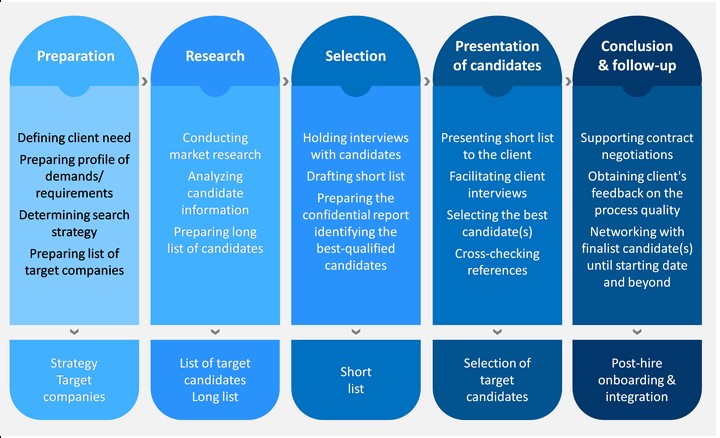
|
|
YOUR
ART RECRUITER
By
keeping our recruiters close to both our
candidates and our clients at all stages of
the recruitment and interview process, the
client can be assured that the ART search will
be more intensely focused, especially if the
search must involve multiple cities or
countries. We never outsource any search, nor do we ever assign important tasks to lesser trained staff. Our clients hire ART because of ART's level of professionalism, efficiency, headhunting methodology, quality of service, and confidentiality. |
|
OUR FEES &
GUARANTEES: ANOTHER ART DIFFERENCE
Our Contract
Terms - the basic points.
Following the client's initial inquiry to us, we evaluate the job's unique details, including the job title, salary range, location, and the degree of difficulty of the search, and then we propose to the client our fee terms in a formal written contract. We only work on a search if there is a full contractual agreement with our client. Once we have stated
our fee terms to the client, that amount would
not change at any time during the search, interview,
or hiring process. We offer this policy so that
our recruiters' work can be oriented to finding the
best possible candidates for our clients' important
needs.
Our
competitors at retainer-focused firms typically charge a
non-refundable full one-third of the total fee for their
research phase. Although they claim to "know everyone,"
the employer is expected to pay a non-refundable
research fee to "investigate the existence of possible
candidates." Sounds more like the plot of The X-Files,
rather than proof of "knowing everyone," doesn't it? ART
would never do such a thing, because we only accept a
search if we believe that our existing industry insider
contacts, candidate base, industry knowledge base, and
headhunting capabilities start with at least a 75%
chance of our finding good candidates that our client
would want to hire. So no need to charge a client for
this phase! We are paid for results.
ART
Shortlist candidates typically are well qualified for
the role based on their work history, achievements,
enthusiasm about the role and client, and the
compatibility of their personal business style to that
of our client's style. Our selecting them as Shortlist
candidates means that we have been successful in
identifying very credible, very strong choices for the
employer. In most cases, a non-refundable
Shortlist fee is charged, but if no suitable
candidates are found by ART, then no shortlist fee
would be charged. If more candidates are presented
later, there would be no additional fee.
With
the exception of a non-refundable Shortlist Fee, if
the employer does not hire our candidate up to 3 years
after presentation, there is no further fee. If we do
not believe that we have found any credible candidate to
offer in a Shortlist, then there is no fee. Results
only.
We have been told by our
clients that our fees are typically lower than those
charged by our competitors, especially for high
salaried positions.
ART
tries whenever possible to discount our fees if there
are multiple placements, so that the client can see an
especially good bargain in continuing to work with ART.
ART's business model relies heavily on long-term repeat
business with our clients, so the better the
relationship with a client, typically the client can
expect very amenable fees from ART placements.
Just
as our clients rightly expect to be paid by their
customers when they deliver their good products or
services to a customer, we at ART equally feel that we
should be paid for our work, even if our client hires
our candidate 3 years after we presented that person
to that firm.
As our
client would well agree, our candidate in that case
would retain his or her industry capabilities,
achievements, and professional expertise without some
arbitrary expiration date, and s/he would remain
well-remembered and highly valued by our client enough
to be offered a job by our client, because our
candidates are that good!
It is
very likely that nobody at your firm willingly works
free of charge, because you and your fellow employees
are needed to grow and manage your company, so your firm
needs to pay you and your colleagues in order to help
your firm. Same with ART.
We
place tremendous value on the quality of our executive
search services, and ART's quality to an employer is
only maintained by our retaining highly competent
recruiters whose experience tends to produce strong
long-term client-candidate matches.
If a
recruiter's hard work and knowledge go unpaid, it
doesn't take long for a good recruiter to leave the
field, causing employers to have to choose among a large
retinue of agencies filled with minimally trained,
minimally valued recruiters. Poorly trained and poorly
appreciated recruiters fill the ranks of most of our
competitors, including the famously high-turnover ranks
of "researchers" employed directly or as third-party
outsourcers by famous retainer-focused firms. We know
what our competitors are like, and we do not want to be
like them in any way.
|
|
WHAT
DIFFERENTIATES ART FROM OTHER
RECRUITERS?
The
ART Simple Model of Executive Search has
allowed our firm since 1987...
to expand globally into the
leading 1,500 metro-areas on six continents; to gain
subtle understanding of dozens of job categories
& their relationship to successful business
models; and to develop recruitment expertise in
dozens of complex industries, including contacts
with a sector's top candidates, so that "we know
where all the pieces fit together."
.
Success
comes to the ART Executive Search Model by
our understanding the intersection of...
a unique company's
unique business model and unique business goal
with a unique person's unique career experience,
unique style and unique career goals.
Other
recruitment firms live by keywords, bots, and
luck...
but ART's decades of
extraordinarily diverse recruitment experiences
have taught us how to thrive and how to correctly
match our excellent candidates with our great
client-companies. That's why our clients give us
repeat business for years, and why our candidates
recommend their most trusted colleagues to us.
|
|
IS THIS THE RIGHT TIME TO USE
ART?
Not every role requires a
specialized headhunter.
We advocate for a "Strategic Efficiency" approach:
Use your internal team for the reachable cases, and
use ART for the critical cases. Review
our Strategic Search Matrix
to see if ART is for your search need.
|
|
ART SPECIALTY SERVICES
High
Confidentiality Searches International
Infrastructure Managing Change:
Fixing or Restructuring Companies Adjusting or
Assembling Your Management Team Startup
Companies |
|
How Should An Executive Search (Headhunting) Firm Serve Your Company? 1.
ART
relies entirely on headhunting.
Headhunting
is a time-tested executive search process also called
"the direct approach method." In this way, candidates,
often recruited at the client's competitors or
near-competitors, are given priority in the candidate
identification and selection process as being the
closest fits and least risky candidate choices for the
client search.
Of
course, other candidates may also be considered, and in
some cases it is even preferable for a company to
consider different candidate experiences. Because your
ART recruiter is very experienced, s/he will know where
to look for candidates, and s/he will understand what
candidates would be best for a client's business goals
and business model.
2.
ART has never used advertising to source
candidates.
***tldr:
Recruitment firms that rely on advertising to find
candidates are not headhunters (even if they
call themselves headhunters) and they are not doing
executive search (even if they describe their
activity as executive search)!
Of
course it makes good sense for an employer to place
advertisements for most of their company's vacancies,
but in special cases when true executive search
(headhunting) is needed to find a very special kind of
person for a very special kind of business mission, then
professional headhunters can bring an employer great
value. The ART recruiter assigned to your firm's search
will have a minimum of 10 years' experience in proper
executive search.
Outside
recruitment agencies that merely place jobs ads and then
wait for some barely acceptable candidates to appear,
are generally a waste of time and money, and they can
create risk due to their incapacity in executive search
recruitment, in terms of presenting the "wrong"
candidates for the "wrong" job. Sometimes they market
their services to a Human Resources department like
this: "We'll place the ads for you; we'll receive a
1,000 resumes; the candidates won't bother you about
follow-up; and then we'll sort the resumes and only send
you the best resumes." That kind of service comes from
an agency that has no useful candidates, and no useful
capabilities or useful contacts to conduct a headhunting
assignment. Their method has nothing to do with
executive search, and it has no particular regard for
either the long term needs of the candidate or the
employer. It's just saying that they know how to place
an advertisement that will get an absurd number of
responses.
A
recruitment agency's reliance on advertisements is an
admission that they do not have useful candidates or
useful industry contacts at the start of the client's
search. What then is their actual value to an employer?
An untrained recruiter is rather a costly, time-wasting,
risk to the employer's business mission, which depends
upon filling the role with the best possible candidate
available. A recruiter who relies on advertising is a
person who has not been properly trained as to where to
find good candidates or how to properly understand what
is good for the candidates' careers, so that recruiter's
advice and judgment is of negligible value to both the
candidate and the employer.
Our client-companies do not hire us to be lucky!
3.
We are in continuous operation,
24/7/365.
Our clients' business
cannot stop because a recruiter is asleep or on
vacation. ART recruits everywhere, so this means that
when other recruitment firms are working, we are
working. When they are lunching, we are working. When
they are sleeping, we are working. Not only does our
model of efficiency help us finish searches faster, it
also allows us to compete effectively in all world
time zones.
Employers working with
ART never feel that there is a time zone lag when
working with an ART recruiter. Ordinarily, working
with ART should feel as easy as working with a local
recruiter in one's own city. This kind of rapid
response and immediacy is critical in order for search
parameters to be continuously fine-tuned between the
employer and the ART recruiter. There is never a sense
of "buck passing" or gridlock when working with ART,
because for us, time wasted is simply not acceptable.
4.
The recruitment breadth and depth of ART is
such that we can quickly understand a
client's vacancy, market, industry or
region, so an employer does not need to
waste time explaining things to an ART
recruiter.
We recruit in dozens of
industries, in over 1,500 metro areas on six
continents, while most other recruitment firms recruit
only in narrow industry sectors, often only in their
own locality.
We recruit in the
general management, sales, marketing, business
development, finance, supply chain, manufacturing
operations, engineering, IT, human resources and legal
disciplines - the key departments upon which a
company's success depends. Most other recruitment
firms only have sufficient experience in one or in
just a few of these disciplines.
Simply put, with nearly
40 years' experience recruiting in our clients'
markets and candidates' fields - and everywhere in
between - "we know where all the pieces fit" between a
company's departments, so we can call upon our deep
knowledge and resources to find just the right kind of
skills that your firm needs to fulfill its key
business mission.
We might well have
already recruited for your firm's direct competitors,
as well as for your suppliers and customers. And if
the search is an international one, ART is one of the
best experienced search firms to understand the
subtleties of different national business cultures. We
can be helpful in making your firm's executive search
less of a high-risk mystery tour and more of a normal
meeting of like-minded people from your industry who
can help take your firm to a higher level.
5.
ART never outsources any search to other
recruitment firms.
By doing
our clients' searches entirely ourselves, we are able to
control the quality, confidentiality, and timelines of
the search.
At ART,
all activity and industry knowledge is centralized, for
efficiency and for the creation of a finer and longer
lasting placement.
Often
when a recruitment firm cannot do a search themselves,
rather than being honest with the employer, they will
brag about "their network," "their partners," or speak
of "multiple offices" scattered around a target
geography, as some kind of proof of their capability to
serve the employer properly. Often they will require
retainers to start the search and a second guaranteed
fee to present a "short list" of candidates who have
been identified by their "partners."
But
here's the dysfunctional problem with the outsourced or
inter-office recruitment model:
(1) they
do not have candidates or useful industry contacts
themselves, even though they describe themselves as
experts in that sector or market or discipline, in order
to gain an employer's trust and advanced payment;
(2) they
do not know where to find candidates; and
(3) the
only way that to offer any candidates is to outsource
your key search to either another office or to
strangers.
Their
method then is kind of like this: you have an ailment,
so you go to your doctor. Your doctor listens to you
talking about your symptoms, but that doctor says that
s/he would not be treating you. Instead, that doctor
brags about there being many other doctors in "the
network" who would be called in to treat you, although
you won't actually ever meet them until you are under
anesthesia on the operating table. You don't get to know
the qualifications or experiences of the others in "the
network," but "that's OK, don't worry," assures your
doctor. And after this chat, you can now go to the
reception desk to pre-pay your surgery, knowing that you
will be well cared for by "the network."
What
are the consequences of an outsourced model of
recruitment?
By contrast, the ART recruiter assigned to your search, and with whom you would communicate initially, would be the same person doing your search, evaluating candidates and presenting candidates to you personally. S/he would be hearing your feedback and the candidate's feedback throughout the hiring process. No information loss!
In this
case, an ART recruiter would not be only looking for
good English communication skills, but the ART recruiter
would also be looking for the foreign candidate to think
bilingually. Foreign accents are OK, and language errors
are usually excusable, but what cannot be lost is an
ability by the foreign candidate to fundamentally
understand the mindset and business culture of the
distant employer.
ART recruiters always
will have at a minimum of 10 years' proven
experience in executive search, typically with
proven successful recruitment in the client's industry
or target region. Simply being located in a country or
city does not automatically make one an executive
search headhunter who has learned how to find
candidates or how to evaluate candidates' experiences
and suitability.
In stark contrast,
ART has never asked any candidate for a fee. All of
our work is employer-paid. We consider recruiters that
extort money from prospective candidates in order to
be considered for a job or who promote friends or
family members ahead of better qualified candidates to
be unethical criminals, and we never would "partner
with" or outsource any search work to such companies.
We do not tolerate discrimination in hiring in any
country for any job for any reason.
Doesn't this "split-fee
multi-agency" or "outsourced recruiting partner"
method for doing your company's key executive search
sound flawed for your firm's important and pressing
needs? Doesn't it sound like a methodology of
recruitment that mostly exists to guarantee maximizing
payment to a recruitment agency and their unknown
partners, rather than to identify the best candidates
to better your company?
And what
happens when your company signs a contract with some
recruitment agency that admittedly cannot do the search
themselves - often because it's an international search
- but then they must scramble to find some recruiters
(any recruiters) somewhere that might actually be able
to do your search? What a mess! This is how a proper
search that might have taken 2-3 weeks ends up taking
six months....
By
contrast, when you work with ART, the recruiter
assigned to your case will be the person whom you will
speak to throughout your search, and s/he will be
personally seeking out, identifying, and evaluating your
candidates for mutual suitability.
After
candidate presentation, during your hiring process, your
ART recruiter will be personally channeling feedback
with you and with any of the candidates being
considered, with the objective of minimizing
misunderstandings, clarifying issues for both sides, and
finding the right person for your firm's key search.
By the
way, it is ART policy that when a search inquiry comes
to us, at the start we estimate our likelihood of our
being successful, and if we do not believe that there is
at least a 75% chance that we could find the right
person for that client, we will not accept the search.
So whenever we do take on a new case, we consider that
search is a priority search!
. |
|
TOP
10 REASONS WHY YOUR FIRM SHOULD ENTRUST ART
FOR YOUR KEY MANAGEMENT SEARCH AT HOME OR
ABROAD:
1. EXPERIENCE
COUNTS. ART has nearly 40 years'
experience in conducting mission-critical
senior level management executive search
assignments for leading corporations in a
wide variety of industries. A recruiter is
assigned to your firm's search only if s/he has
had a minimum of 10 years' experience in senior
management executive search. Proper executive
search is not an easy profession, and those who
have proved themselves over the duration are those
who know how to serve their clients and candidates
well.
2. OUR RECRUITMENT METHODOLOGY IS SUPERIOR. ART is a U.S. executive search firm whose recruiters bring the highest level of American executive search (headhunting) to the world. Why should this be important to you? Because in America, since the 1960's, there has evolved a great distinction between recruitment firms that do executive search headhunting and employment agencies, which only know how to place advertisements for employers. Leading corporations only trust their key management searches to executive search firms. But in much of the world, even if the firm claims to do executive search, their typical practice of recruitment is often limited to the passive placement of advertisements and the hit-or-miss nature of sorting through incoming resumes. At most of our competition, ad-response candidates are typically sorted by poorly trained staff who have minimal understanding of careers, corporate business structures, or even their clients' products and technologies. For most, it's just a temporary gig and not a profession. If your company is seeking a key manager to help your company, shouldn't that search be done by a recruitment professional? 3. WE SEEK CANDIDATE EXCELLENCE, NOT MERE AVAILABILITY. ART recruits everywhere on earth using the exact same standards, methods and expectations. All countries have differences that need to be understood, but never should our client accept a candidate anywhere who is not up to the same high standards as similar employees in other countries. 4. ART RECRUITERS
HAVE HIGH REPUTATIONS. ART
recruiters working on your search often have
world-famous reputations in executive search,
including interviews in the world's
leading business publications. We
make available transcripts of most of these
interviews on our website. 5. ART RECRUITS IN YOUR CITY, ACROSS YOUR COUNTRY, AND GLOBALLY. ART recruits globally in over 100 countries, in the top 1,500 world centers of business, industry, finance, and creativity. We are able in the briefest of time to enlarge a search radius from a single metropolitan area, across a country, throughout a continent, or globally. Our objective is to find the best local candidates whenever possible, but if a wider scope is needed, in order to provide more varied choices, ART is uniquely qualified to lead that search effort. 6. TOP MANAGERS IN YOUR INDUSTRY TRUST ART. Because our candidates know that we care about their long term career successes, a great many of these industry leading talents look to ART for their career options. Not only are we able to tap great candidates who have sought us out, but many of these top managers in your industry happily and confidently refer their most capable colleagues to ART when we have a fitting client search. Trust, longevity, and competence work to everyone's advantage. 7. ART CONTROLS ITS ENTIRE SEARCH PROCESS. ART does all of our search work through our own recruiters. We do not outsource our recruitment to any other firm for any search. By not outsourcing with any other firm we are able to control the quality of the search, as well as the time lines and ethics. These matters are greatly important to us in properly serving our clients and candidates. 8. ART IS IN
CONTINUOUS OPERATION, 24/7/365. When
our competitors are working, we are working.
When they are having lunch or dinner, we are
working. When they are asleep, we are working.
So is it really surprising that ART beats out
other recruitment firms, even in their own
cities and countries? 9. ART IS FAST
WITHOUT SACRIFICING EFFICIENCY. Most
searches involve the identification of suitable
candidates in 1-2 weeks, with candidate contact
and evaluation typically being in weeks 3-4. In
most cases a client can expect to see candidate
resumes or CV's 3-4 weeks after the
start of the search. Clients are updated with
progress reports on at least a weekly basis, and
if the search parameters need to be fine-tuned,
we would do so quickly with the advisement of
our client. 10. WHEN ART TAKES ON A SEARCH, WE TAKE THE RISK, NOT THE CLIENT. We only accept a search if we have determined that we have at least a 75% chance of finding candidates that the client would want to hire. This calculation is made as a "best guess" at the start of the search, but it is an "educated guess," based on our knowledge of the client's industry, the local market, and the attractiveness of the opportunity for our candidates. 11. WE WORK EXTRA HARD TO EARN YOUR LOYALTY. We added an 11th reason to work with ART to show that at every stage of our relationship, we try to add more value to you and your firm. Reduced fees on multiple searches, for example. |

©2026 Atlantic Research Technologies. All rights reserved
HOME